

Welcome to the 353rd edition of the Data Reaper Report! This is the first report for Violet Hold.
Contributing to the Data Reaper project through Hearthstone Deck Tracker or Firestone allows us to perform our analyses and to issue the weekly reports, so we want to wholeheartedly thank our contributors. Without the community’s contributions, there would be no project. Contributing data is very easy, so if you enjoy our content and would like to make sure it remains consistent and free – Sign up!
Quick Links
Class/Archetype Distribution | Class Frequency | Matchup Winrates | vS Power Rankings | vS Meta Score | Class Analysis & Decklists | Meta Breaker of the Week | How to Contribute | Credits

Number of Games
| Overall | 2,813,000 |
| Top 1K Legend | 81,000 |
| Legend (Excluding Top 1k) | 315,000 |
| Diamond 4 to 1 | 558,000 |
| Diamond 10 to 5 | 660,000 |
| Platinum | 465,000 |
| Bronze/Silver/Gold | 734,000 |
Class/Archetype Distribution
-
All Ranks
-
D1 to D4
-
Legend
-
Top 1K Legend
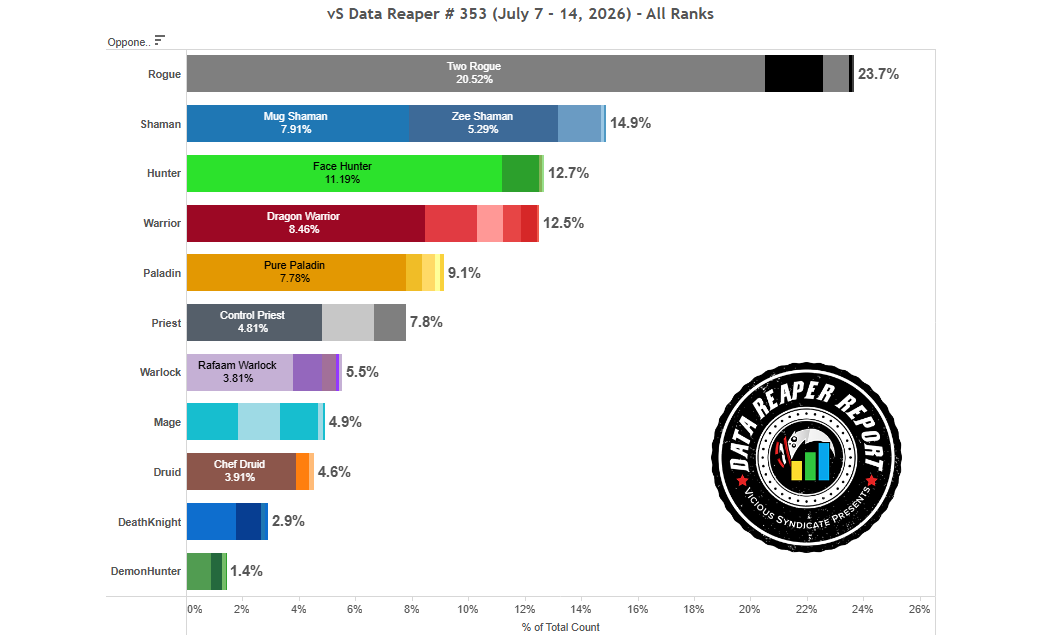
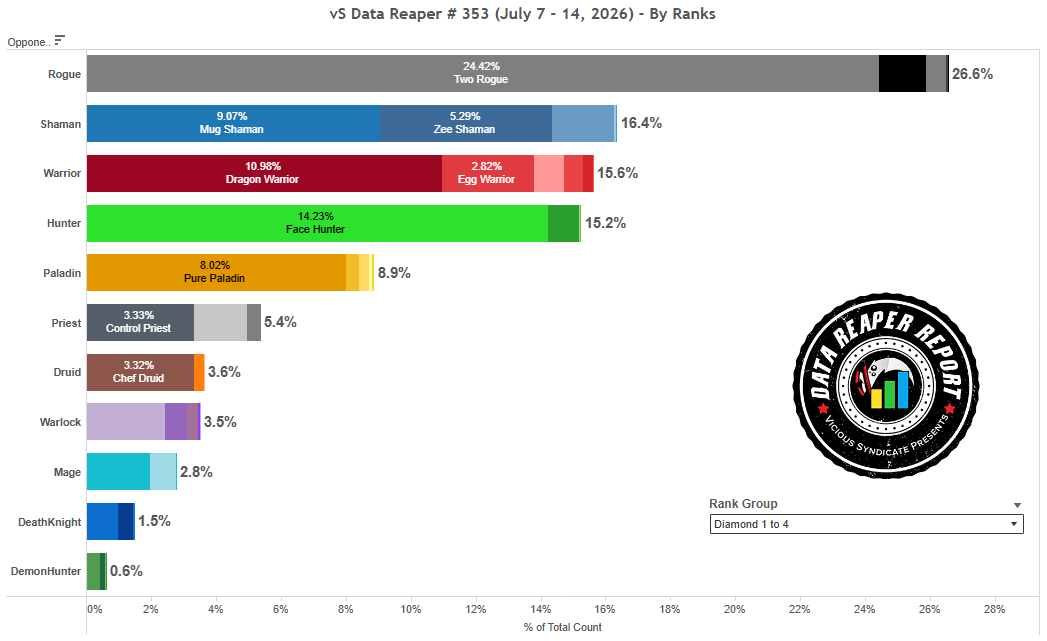
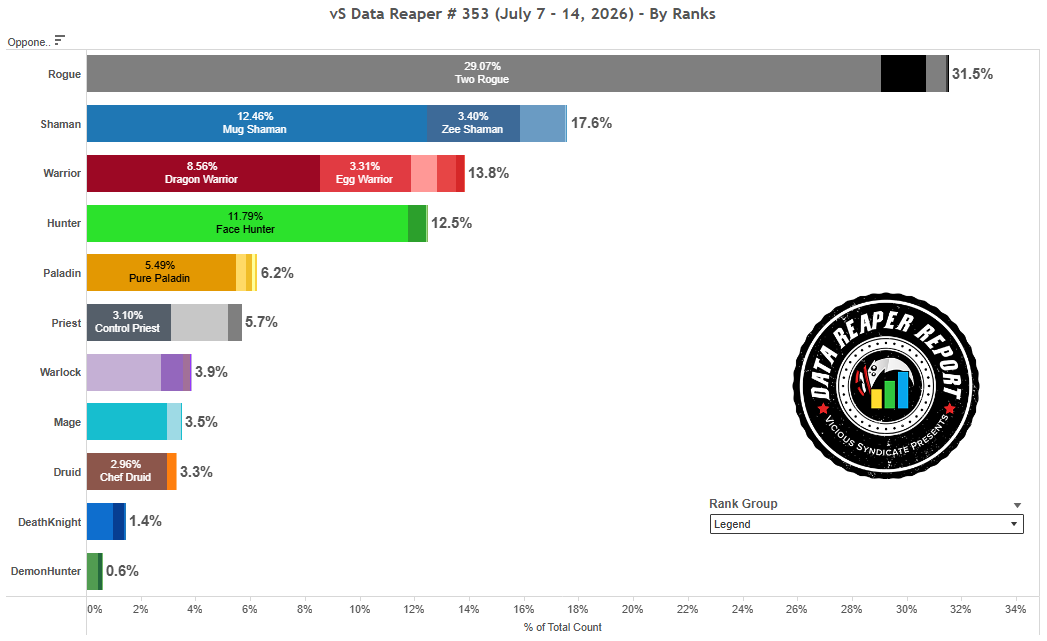
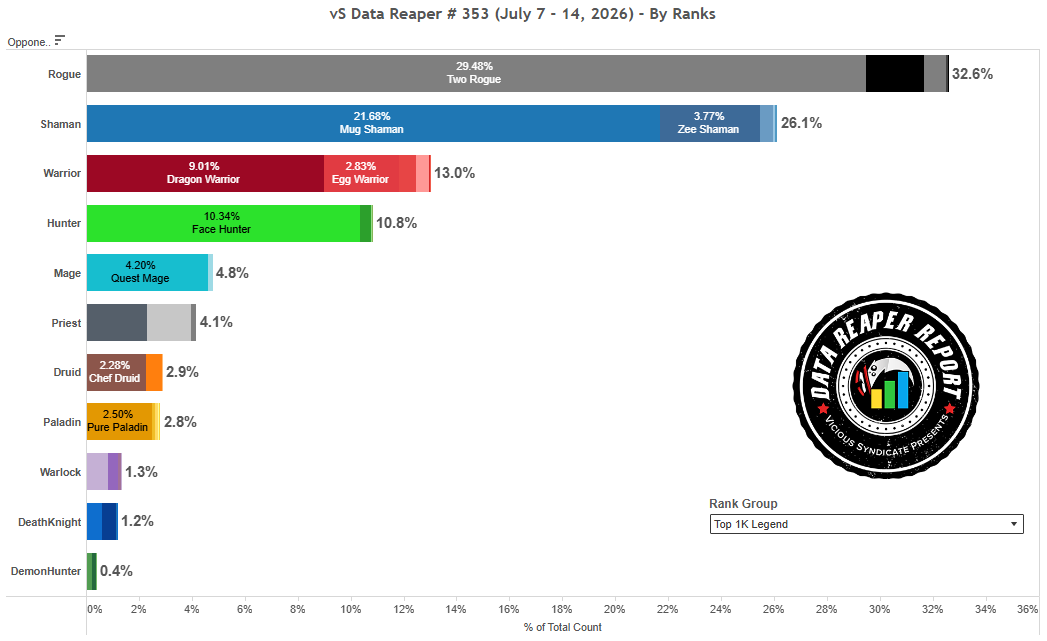
Class Frequency
-
Weekly
-
Daily
Class Frequency Discussion
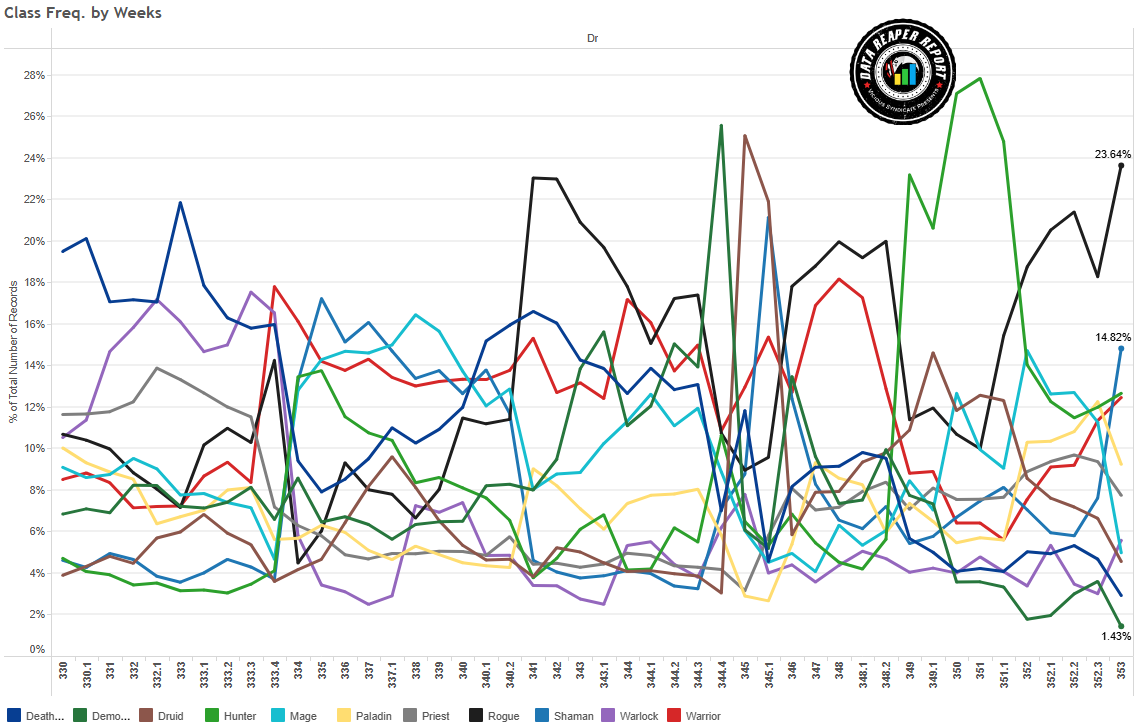
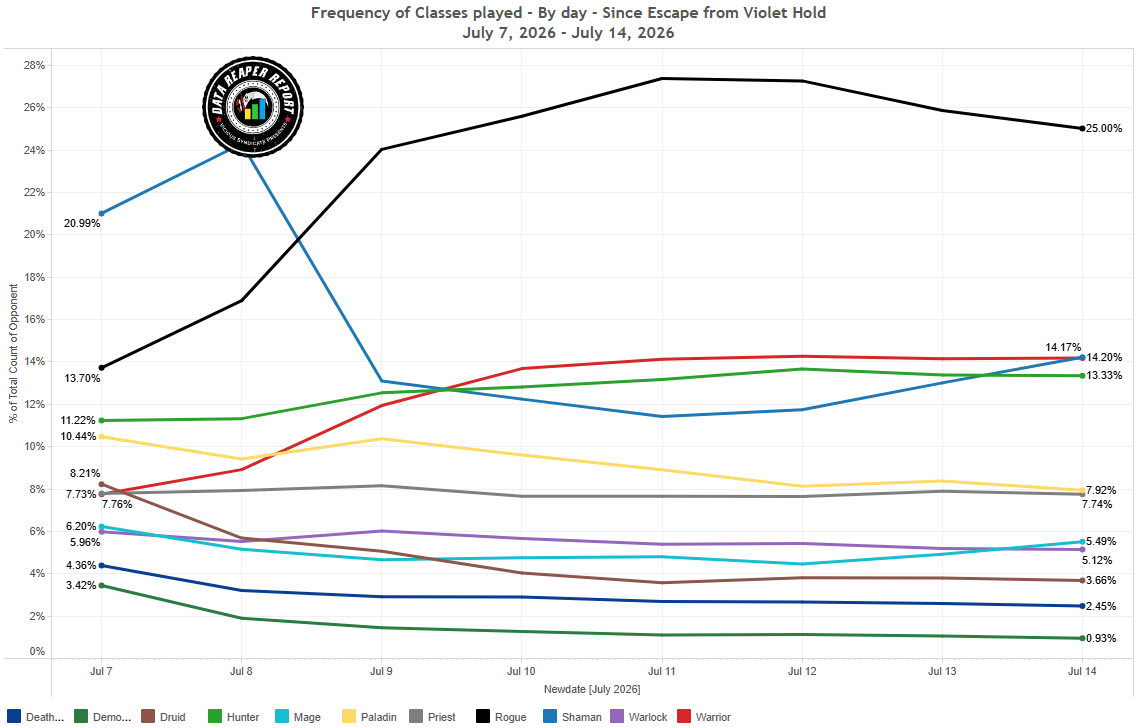
The most popular new deck across ladder on the first week of the expansion has been Two Rogue, which is the Rogue deck built around Troublemaker and Jade Guardians alongside a long list of 2-cost cards to fuel them. Herald Rogue is visible, but the dominant archetype from Cataclysm has been left behind.
The other new deck gaining momentum and spiking in its popularity is Mug Shaman. This is the Mug’Zee deck without minions. Zee Shaman, the Mug’Zee deck without spells, was popular until the ban on Slagclaw, which had a bugged interaction with the hero power. Zee Shaman has faded away since.
Dragon Warrior with Warptooth has a strong presence at all levels of play, while Egg Warrior exhibits a steady, but low play rate.
Face Hunter with the Tripwire package is the last deck exhibiting a strong ladder presence that does not diminish at upper rank brackets.
Pure Paladin, with or without Beatrix, is a popular deck at Diamond ranks and below, but significantly declines at legend ranks.
Priest is experimenting with two decks. We are familiar with Atiesh Control Priest from Cataclysm. A Soothsayer Priest deck has also emerged, leveraging Undeath Sentence and Umbra.
Mage is struggling to adapt to the format. It only forms a clear identity at top legend, where Quest Mage displays a modest presence.
A small presence of Chef Druid, built around Chef Neth’rek, is all that Druid has to show for itself. This deck is declining over time.
The player base has given up relatively quickly on Warlock, Death Knight and Demon Hunter. Not much is going on here.

-
All Ranks
-
D4 to Legend
-
Legend

-
Top 1K Legend
-
Legend
-
D1 to D4
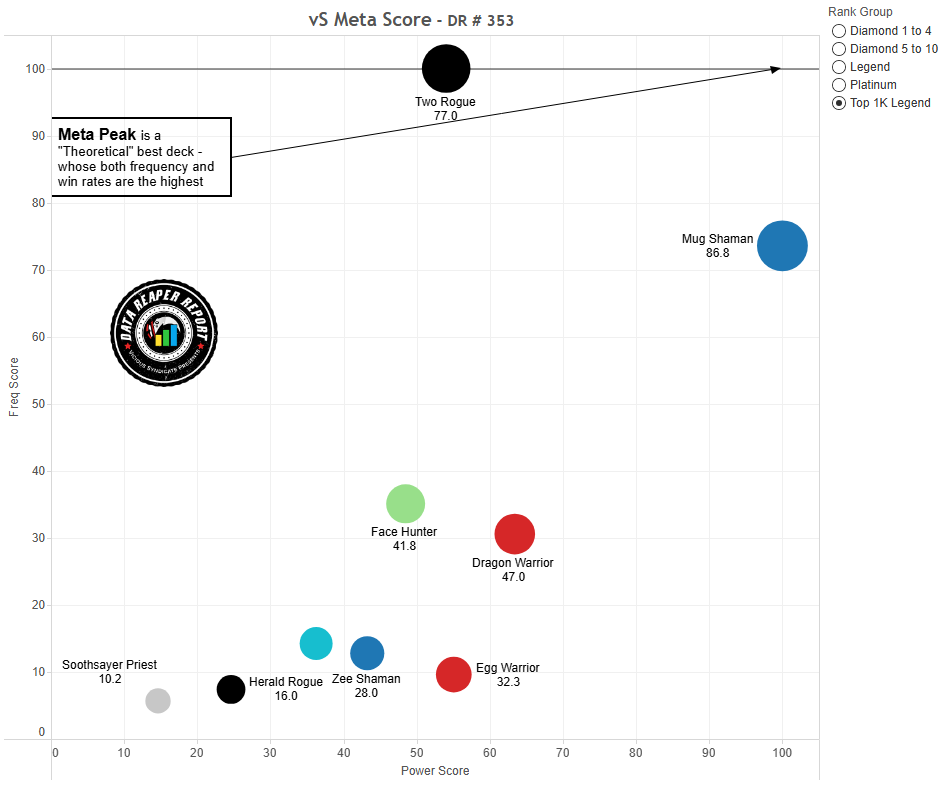
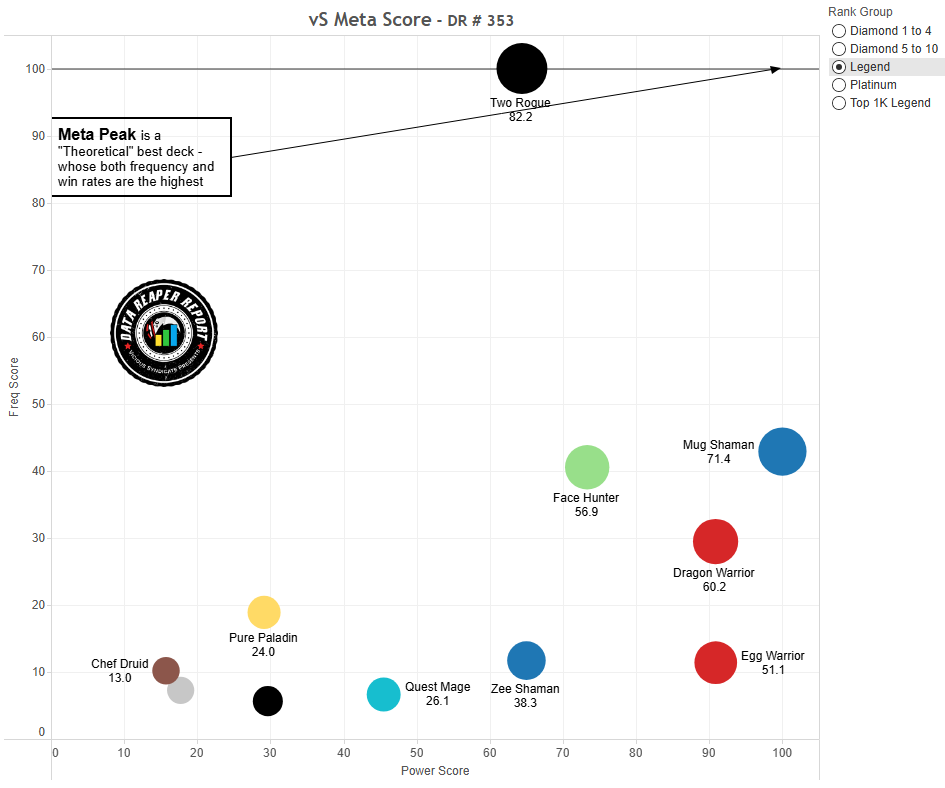
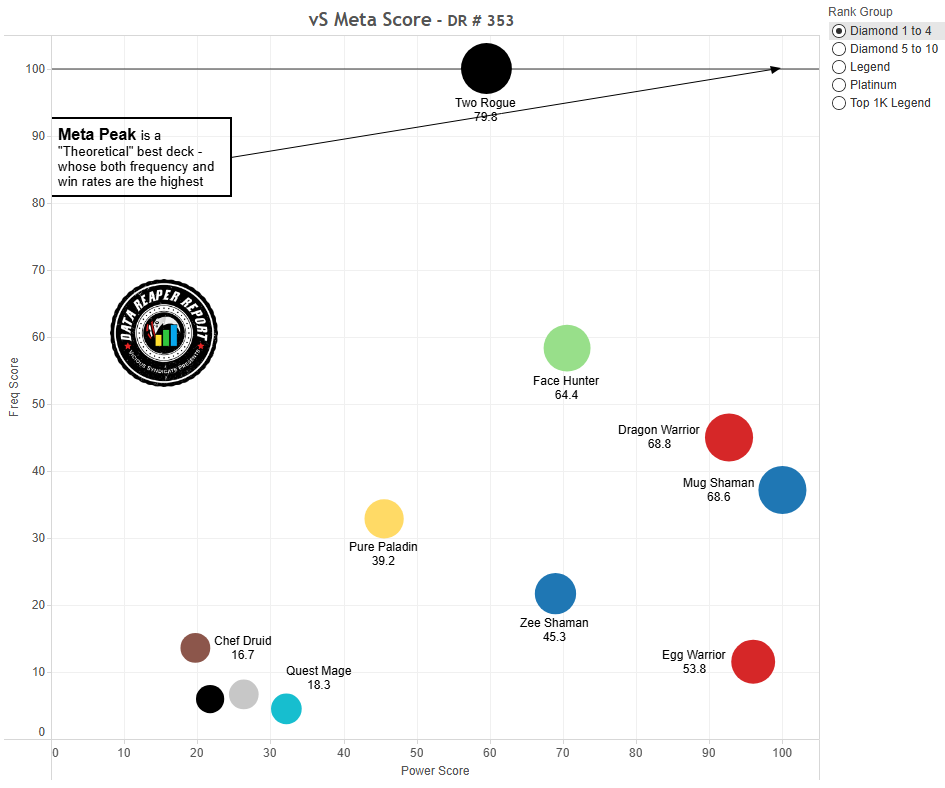
vS Meta Score
-
Top 1K Legend
-
Legend
-
D1 to D4
vS Power Rankings Discussion
Shaman
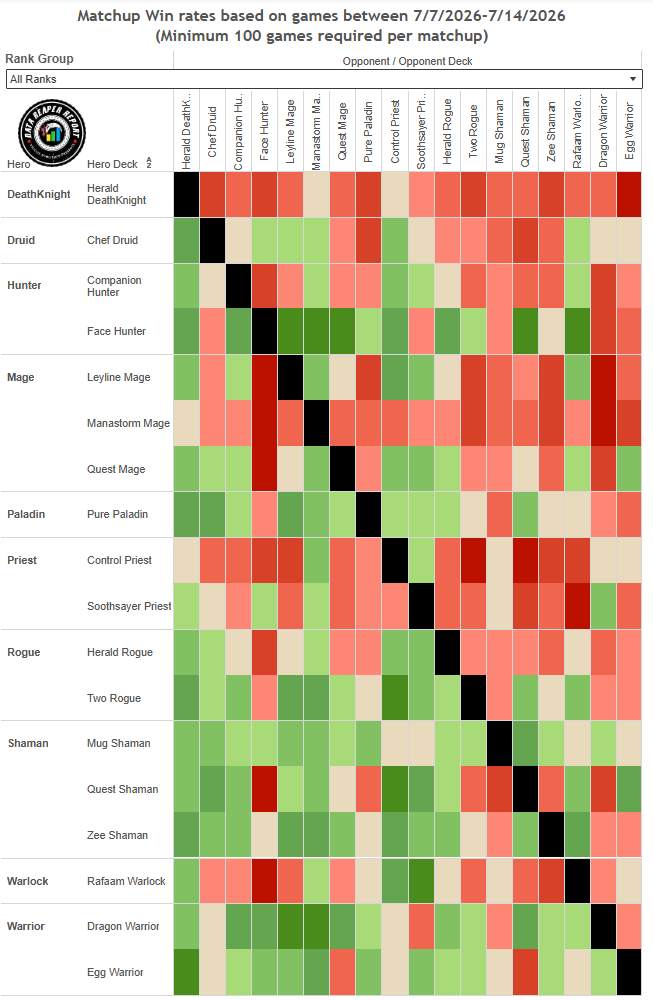
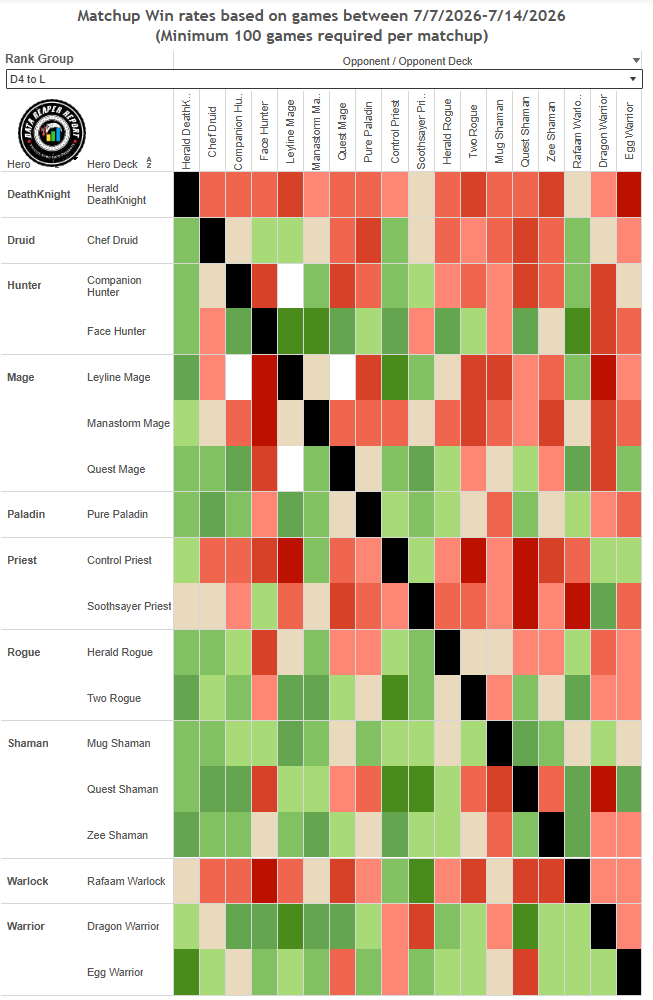
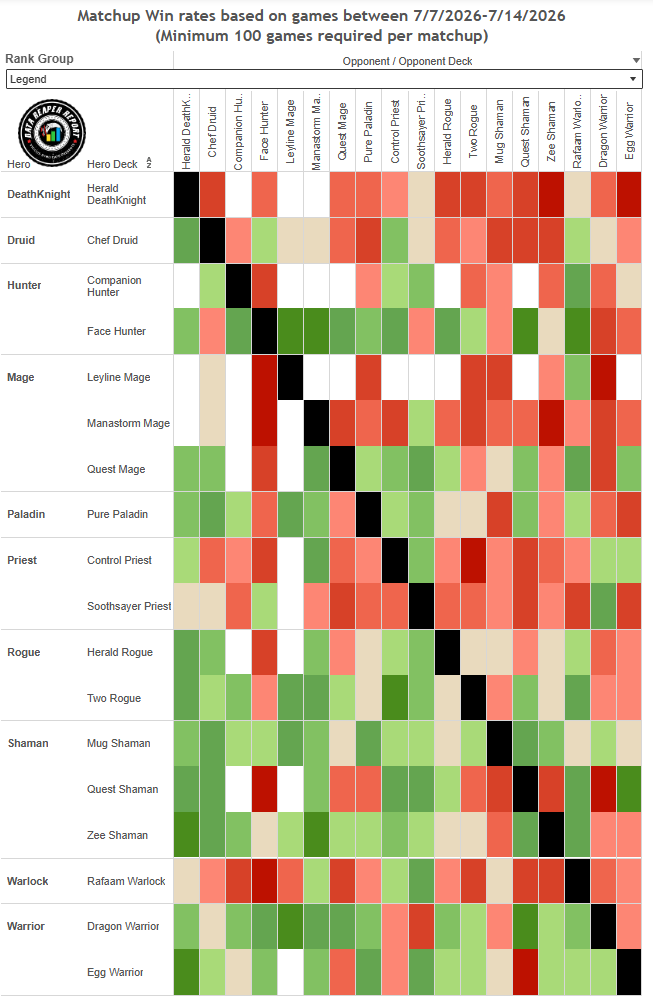
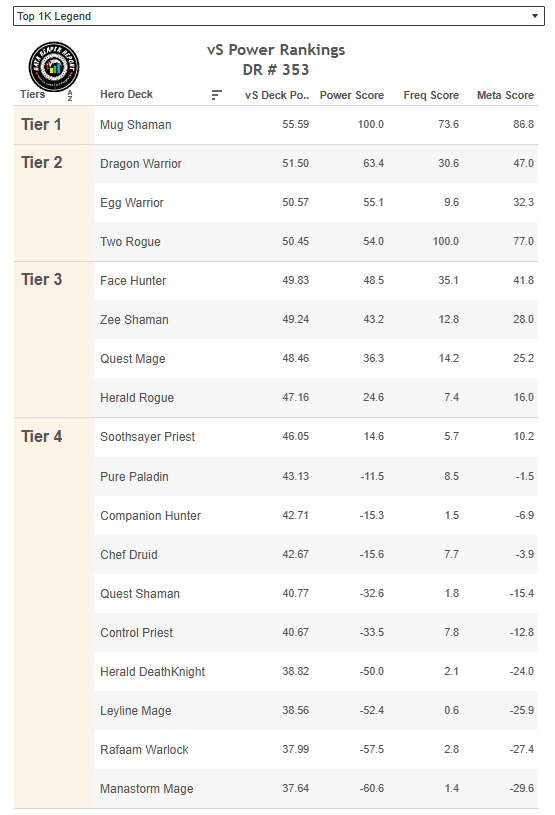
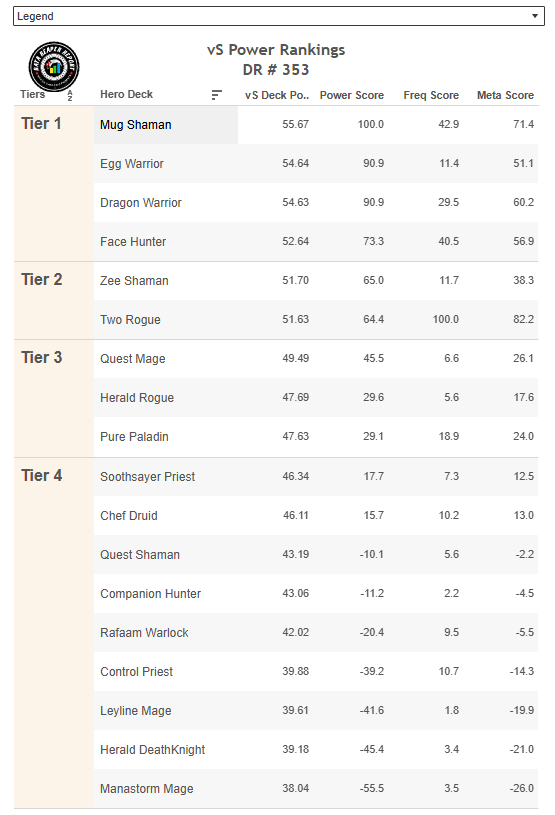
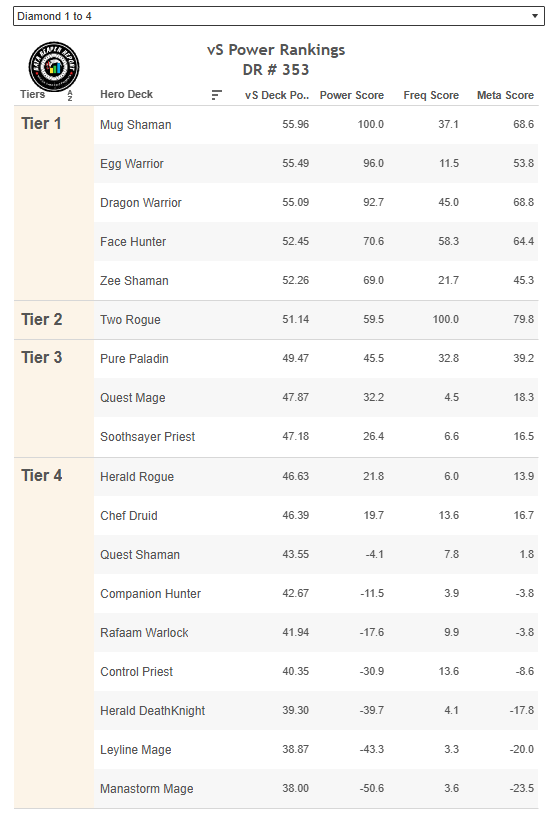
- Mug Shaman is proving to be overpowered at a game breaking level. It is the best deck in the game across ladder, but at top legend, where the meta is more advanced in its development, it is completely uncontested. Nothing comes close to it and nothing, at first glance, seems capable of countering it.
- To understand why this deck is so wildly overpowered, we evaluated its metrics and came to a clear conclusion why we underestimated it and why Team 5 did not realize how strong it is in their testing either. Its ability to cheese opponents in the first few turns is surprisingly consistent through either Blazing Invocation or Mountain Map. Low Security Wing, which limits the pace in which we can drop its generated minions, does not perform nearly as well. But Blazing Invocation and Mountain Map are so strong in this deck that they are the only cards worth seeking in the mulligan. Mug Shaman dominates the format by snowballing early with those first couple of discovered minions.
- This early minion generation allows Mug Shaman to dominate early game board control, denying faster decks the ability to establish their own initiative. Meanwhile, defensive decks with removal, which can theoretically answer the first few threats and deplete the Shaman of resources later in the game, are not competitively viable whatsoever. We found that a refined Control Priest list is slightly favored against Mug Shaman, but the deck has other issues in the format, which we will discuss later.
- The clear solution is to nerf Blazing Invocation and Mountain Map. While the deck’s hero power is still potentially powerful, if Mug Shaman cannot checkmate opponents on the first three turns, its ability to overwhelm them with its mana advantages is greatly diminished.
- Zee Shaman initially looked strong before the Slagclaw ban, but even with this bugged interaction, its performance was in the process of declining to the point its win rate sank under 50% at top legend. Its future performance will largely depend on the extent of balance changes we see in other decks.
Rogue
- Two Rogue is a very powerful deck that is arguably oppressive in slower matchups due to its scaling off-board damage. Most slower decks get completely obliterated by Troublemaker, so its large presence has completely pushed them off the format. The emerging field with Shaman, Warrior and Hunter, is built to kill Rogue before it can scale its damage to unmanageable levels. Against the best decks in a format largely influenced by this deck, Two Rogue does not match up particularly well, though it does well enough to maintain a positive win rate.
- Therefore, it may not come as a surprise to hear that Troublemaker is nowhere near the best performing card in the deck. It is a strong card to have in the opening hand, but it is not a reliable win condition against the best decks.
- Vanessa, as well as our ability to tutor it with The Kingslayers, is the most impactful factor in the deck. It allows Rogue to cheese faster opponents early and provides it with fuel to sustain pressure in slower matchups. Jade Guardians is also a stronger performing payoff compared to Troublemaker because it is a consistent path for Rogue to swing the board state back in its favor when it is under pressure.
- Two Rogue’s high prevalence, which is a function of being one of two available new decks in this expansion that are competitively viable and strong (a concern we should note), will lead to it getting nerfed. But the question is how will Team 5 approach Two Rogue. Will they balance for the current format and accept its effectiveness in non-existent slower matchups, or will they balance for a format they envision, one with slower decks that they hope become more viable? One thing to keep an eye out for.
Warrior
- Dragon Warrior performs well against Rogue and Hunter, so its overall standing is strong despite an unfavored Mug Shaman matchup. Notice that at top legend, where the population of Mug Shaman significantly grows, Dragon Warrior clearly falls behind. It is the best deck of the rest.
- Egg Warrior matches up well against the top 4 classes, though it gets countered by the less popular Mage and Priest. Its matchup against Mug Shaman is dependent on the number of Hex copies in the Shaman’s deck. It is uniquely effective against Two Rogue despite being a slow deck, due to armor gain and Egg of Khelos making the game more difficult for Lotus Troublemaker to close out.
Hunter
- Hunter is the 4th and last class that possesses a deck with a positive win rate past Diamond 5. Face Hunter has greatly benefitted from the additional damage coming from Arcane Tripwire. Its matchups against defensive decks with life gain has drastically improved compared to the days of Cataclysm. It is favored against Two Rogue, but this advantage shrinks at higher levels of play against better Rogue players, while it is clearly unfavored against both Mug Shaman and the two Warrior decks. Therefore, it drops off in a more developed format.
Paladin
- Pure Paladin performs well at low MMR brackets but once we hit Diamond 4, the deck starts to struggle until it becomes completely unplayable at top legend. An extremely low skill ceiling and an oppressive Mug Shaman matchup are the causes.
Priest
- A refined Control Priest build is possibly the only (soft) counter to Mug Shaman thanks to an excellent early game removal toolkit as well as its ability to sustain through the Shaman’s finite amount of board pressure. But Control Priest’s win rate against Two Rogue is 25%, making it impossible to succeed with the deck unless the player miraculously dodges the horde of Rogues that can be found at all levels of play. Its matchup against Face Hunter, which used to be a piece of cake, has turned into a nightmare too. Hunter simply has too much damage following the addition of Arcane Tripwire.
- Soothsayer Priest’s matchup against Hunter is far better. The Rogue matchup is also not as terrible. But the Mug Shaman matchup is significantly worse due to the deck’s vulnerability to Hex, so Soothsayer Priest falls short against the two most popular classes in the format.
Mage
- Quest Mage has a close matchup with Mug Shaman since it can occasionally clear its first few threats, but its matchups against Dragon Warrior and Face Hunter are horrendous, while Two Rogue is not easy either. It is a strong counter to Priest and Egg Warrior.
Druid
- While Chef Druid does not look as horrible as some other failed new archetypes we can observe in other classes, it is still ultimately doomed. It loses to the top 4 classes, without exception.
Death Knight, Warlock and Demon Hunter
- These classes are at the very bottom of the food chain. Based on a very low sample size that we have no confidence on, it is possible that Unholy Death Knight and Egg Warlock are not bad. But everything else looks terrible.
- While Mug Shaman and Two Rogue have clearly transformed the format, the depth of new strategies introduced with this expansion is very low. If we do not introduce convincing buffs, nerfing Mug Shaman and Two Rogue may swing us right back to Cataclysm New Game+.
Class Analysis & Decklists
Death Knight | Demon Hunter | Druid | Hunter | Mage | Paladin | Priest | Rogue | Shaman | Warlock | Warrior

Our main finding about Two Rogue is that Thief’s Tools is not particularly strong and there are plenty of 2-cost cards we would rather run instead. We were planning to feature two builds: one with a Murloc package and one without. However, the Murloc package is getting hotfixed today, leaving us with one functional list.
Bitterbloom Knight is strong, but Eventuality is not. Bloodmage Thalnos is a nice card when we run two copies of Backstab and two copies of Fan of Knives. Cult Neophyte is a solid card against Shaman and Rogue, so it can replace Shadowed Informant.

The best Mug Shaman list is solidifying. We can run two copies of Hex instead of either Ascendance or Fire Breath. Voltaic Burst is another card we can run two copies of, but it does not perform that well, as it is usually more useful later in the game.
Zee Shaman has not worked well since the ban on Slagclaw, so we will work on refining the archetype once we have clean data on it without bugs.

Mother Duck is nuts in Dragon Warrior and a core inclusion due to the ease in which it activates Warptooth.
The Egg Warrior list from last week’s article looks clean. The second copy of Decimation looks like the most cuttable card if we ever need to add something else.

Face Hunter has two slightly different builds that are viable. Beast Tripwire is not a strong performer in the archetype, but it does not look like a clear liability, so we have kept it. The faster build is straightforward: It is Cataclysm Face Hunter with the Tripwire package and Underbelly Network.
The slower build is a bit more defensive, running King of the Underbelly with Agamaggan and Briarspawn Drake for a big burst turn. Earthen Roar enhances Briarspawn Drake’s potency. The Felrattler inside King of the Underbelly is not important and can be replaced with other options.
The faster build is better against Rogue, Hunter and Mage, while the slower build is better against Shaman, Priest and other slower decks.

Both the Beatrix and non-Beatrix variants look viable in Pure Paladin. So far, the difference in their performances in different matchups is small.
The key is to run Violet Treasuregill even in the Beatrix build and just accept the smaller percentage outcome of Treasuregill getting pulled by Scarlet Recruiter or Reinforcement Aura.

Control Priest looks fine against most decks when correctly built, but the awful Rogue and Hunter matchups make competing with it difficult. Soothsayer is a strong addition to the deck. The featured build has a good matchup against Mug Shaman.
A dedicated Soothsayer Priest deck performs much better against Hunter and Rogue but loses percentages in other matchups.

First Flame is good in Quest Mage these days because early game removal is valuable in the emerging format to deal with Mug Shaman’s first few threats. The Skeleton Key is a good card for the archetype.

Chef Druid needs to be built defensively to stand a chance, though it also needs to make sure it possesses strong turn 6 swings. Kaldorei Cultivator is important alongside Contingency for the archetype’s late game.




Hard mulligan for Blazing Invocation and Mountain Map and you should have an easy time climbing with Mug Shaman. The deck’s early game cheese feels like an exploit, rather than intended Hearthstone gameplay. This will not survive after next week, when the first balance patch of the expansion will likely arrive.
But what happens after is anyone’s guess. We will be there to draw a new picture.
Preparing our weekly article requires a significant amount of time and effort from many individuals. We would like to wholeheartedly thank our current Patreons, whose generous donations help us fund computing and server costs.

vS Gold is our membership plan aimed to support our efforts towards improving our content and data analysis while receiving some bonuses and extra features.


Tier 3+ Patrons
Special thanks to William H, Amir, Joltc, The Big Dawg, Jesse M, Josh G, WorldEight, Wyatt P, Dooshenbarf, BraveSurRobin, Clint D, Michael D, PapaPloKoon, Nick M, Dennis W, Jeffrey B, Whomprat, R, Seth D, The Drs. Link, Darterrius, lepton, Travis F, Timothy M, Nuutti, and Eva for supporting us this month.
Here are all the people that participated in bringing you this edition of the vS Data Reaper Report:
Contributors